Where Used
The "where used" view shows you every BOM that uses a specific product as a component. It answers the question: "if I change or run out of this item, what finished goods are affected?"
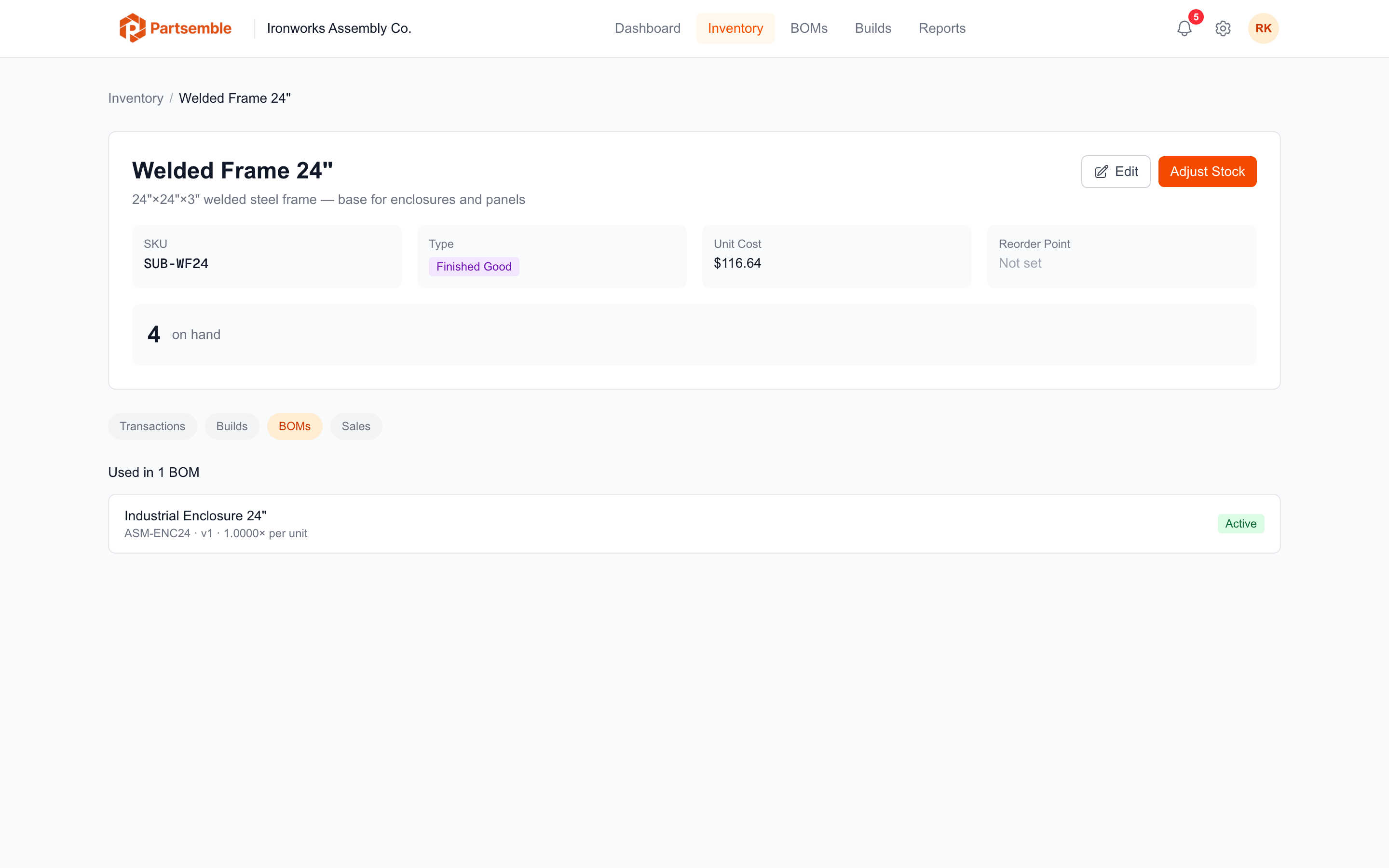
Viewing Where Used
Navigate to any product's detail page and look for the Where Used section. It lists every BOM that references this product as a component, showing:
- Parent product — the finished good or sub-assembly that uses this component
- Parent product SKU — for quick identification
- BOM version — which version of the parent's BOM includes this component
- BOM status — whether the BOM is Active, Draft, or Archived
- Quantity per unit — how much of this component is consumed per unit of the parent product
When Where Used Is Helpful
Stock shortage impact analysis. A raw material is running low. Before you decide what to prioritize, check where it's used to see which finished goods will be affected and how severely. A component used in 5 products at high quantities is more urgent than one used in a single product at low quantities.
Component substitution planning. You're considering switching from one supplier's material to another. Where used shows you every BOM you'll need to update.
Obsolescence management. You're discontinuing a component. Where used tells you which BOMs reference it, so you can update or version them before removing the product.
Cost impact assessment. A supplier raises prices on a raw material. Where used shows you which finished goods are affected, and by looking at the quantity per unit, you can estimate the cost impact on each one.
Example
You manufacture three finished products. Your raw material "14-Gauge Steel Sheet" shows the following in its Where Used section:
| Parent Product | SKU | Version | Status | Qty/Unit |
|---|---|---|---|---|
| Industrial Enclosure 24" | ASM-ENC24 | v1 | Active | 2.0 |
| Machine Safety Guard | ASM-GARD | v1 | Active | 1.0 |
| Door Assembly 12"x18" | SUB-DB12 | v1 | Active | 0.25 |
If you have 30 sheets of 14-gauge steel in stock, you can quickly see that this supports 15 enclosures, 30 safety guards, or 120 door assemblies — and that a price increase on steel affects all three products.
Where Used and Nested BOMs
Where used shows direct references only — the BOMs that list this product as a component. It does not show indirect usage through nested sub-assemblies.
For example, if Product A uses Sub-Assembly B, and Sub-Assembly B uses Raw Material C, then Raw Material C's where-used list shows Sub-Assembly B (direct reference), not Product A (indirect). To trace the full chain, check Sub-Assembly B's where-used list to find Product A.