Rejection Reasons
When you reject a build during QA review, you select a reason that categorizes what went wrong. This creates a record you can use to identify patterns, address recurring issues, and improve your production process over time.
Available Reasons
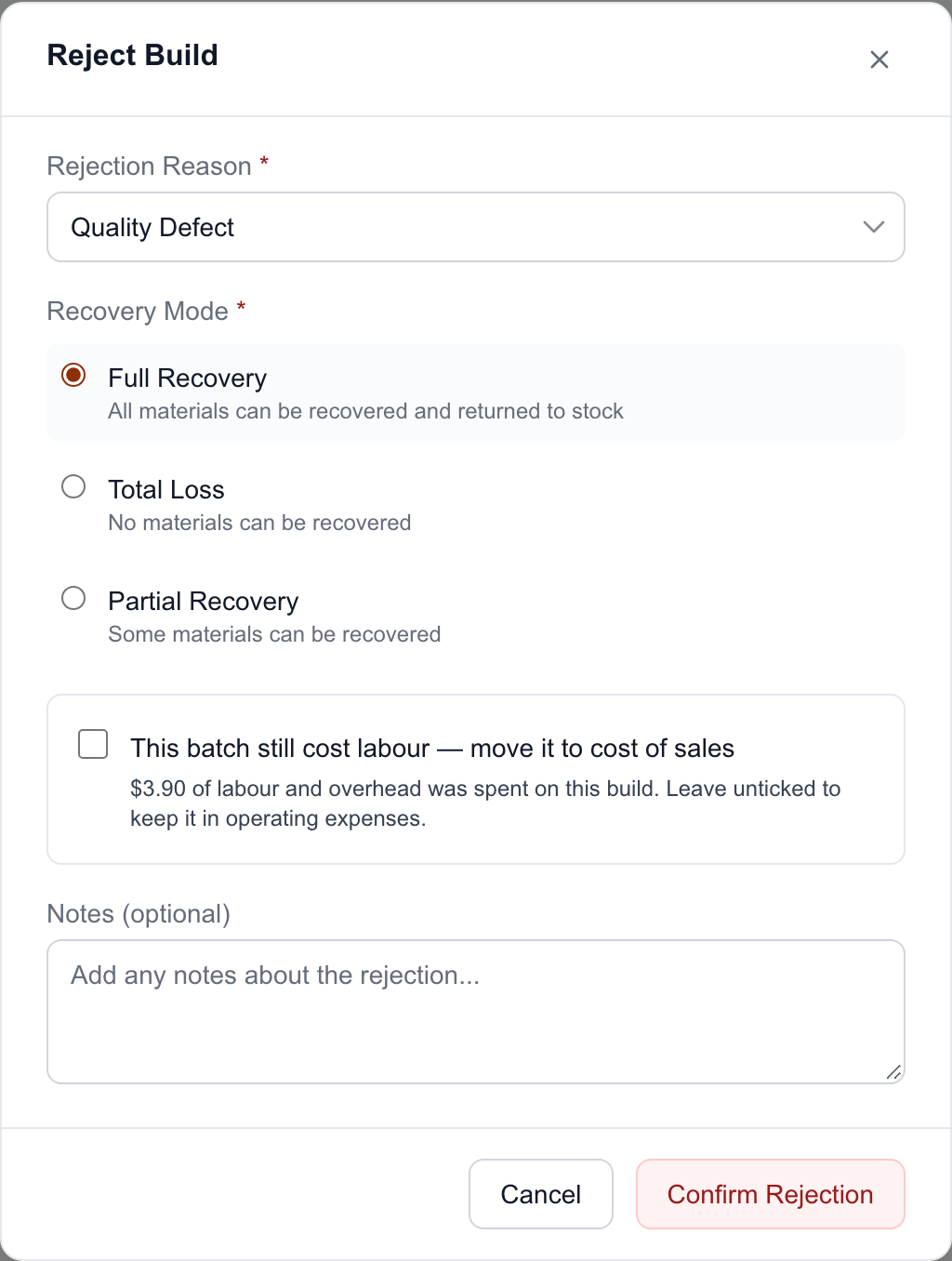
Quality Defect
The finished product was built correctly but doesn't meet quality standards. The output has a defect — in colour, finish, consistency or packaging — that makes it unacceptable.
Examples: a batch of Acrylic Trim Enamel, Midnight Navy came out visibly off-shade against the standard, a stain's viscosity is out of spec, a can of Porch & Floor Enamel was filled short, lids didn't seal.
Wrong Materials
The wrong components were used during the build. This could mean the wrong product entirely, the wrong variant, or the wrong lot of a component.
Examples: Tint Paste, Lamp Black was added where the formula called for Tint Paste, Phthalo Blue, a quart can was used for a gallon product, a lot of Acrylic Enamel Base from the wrong supplier was consumed, the wrong product label was applied.
Equipment Failure
A machine, tool, or piece of equipment malfunctioned during production, causing the build to fail.
Examples: the shaker stopped mid-cycle and the tint didn't disperse, the tint dispenser over-dosed a colorant, the filler head dripped and short-filled a run, the lidding press dented the cans.
Process Error
The production process wasn't followed correctly. The right materials were used and equipment worked fine, but a step was missed, done in the wrong order, or done incorrectly.
Examples: cans were filled under the wrong product's label, the additives went in before the base, shaker time was cut short, a batch was canned before its colour was checked.
Other
For situations that don't fit the predefined categories. Use the rejection notes field to describe what happened.
Choosing the Right Reason
Pick the reason that best describes the root cause, not the symptom. If a batch of enamel came out off-shade because the tint dispenser over-dosed a colorant, that's an Equipment Failure (the dispenser), not just a Quality Defect.
If multiple issues contributed, choose the primary cause and use the notes field to describe the full picture.
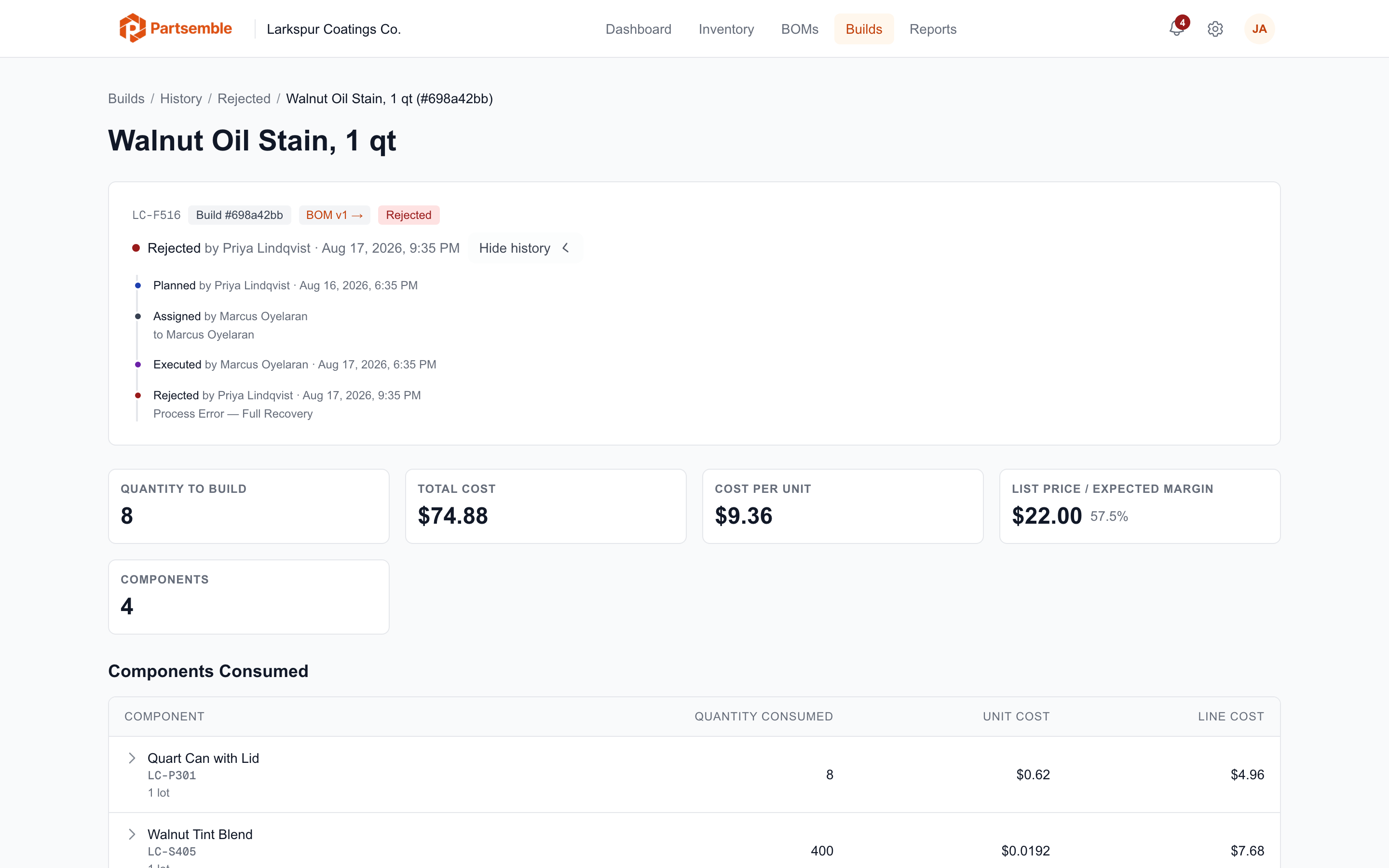
The reason appears in the build's history together with the recovery mode, as in "Process Error — Full Recovery" for Larkspur's batch of Walnut Oil Stain, 1 qt that was filled under the wrong label.
Review your rejection history periodically. If you see a pattern — the same reason showing up repeatedly for the same product or process — that's a signal to investigate and fix the underlying issue.