Lot Tracking
Lot tracking gives you full traceability for every unit of inventory — from the moment it arrives through production to the finished good. Each incoming shipment creates a lot, and when you build, Partsemble tracks exactly which lots were consumed.
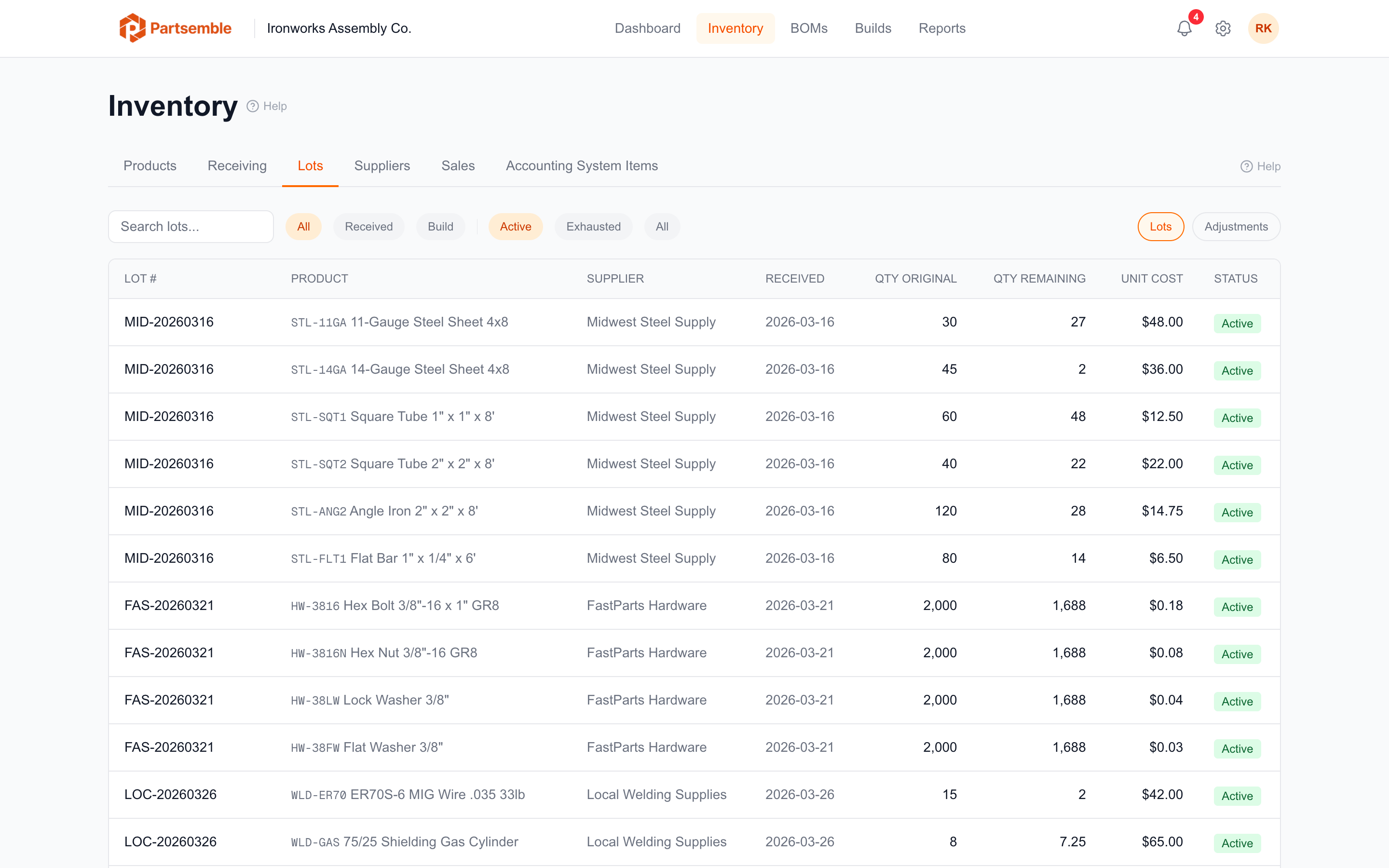
What Is a Lot?
A lot is a batch of a specific product received at a specific time, from a specific supplier, at a specific cost. Each receipt line becomes a lot. A lot has:
- Lot number — a unique identifier (auto-generated or manually entered)
- Product — which product this lot contains
- Quantity — the original quantity received
- Quantity remaining — how much is still in stock (decreases as lots are consumed by builds)
- Unit cost — the purchase price per unit for this lot
- Expiry date — optional, for perishable products
- Status — active (has remaining stock), exhausted (fully consumed), or voided
Lot Numbers
Each lot has a unique number. Partsemble auto-generates lot numbers from the supplier code and received date (e.g., "ACM-20260404"), but you can enter your own — for example, your supplier's batch number or an internal tracking code.
Lot numbers must be unique per product among active lots. Two different products can share a lot number, but two active lots of the same product cannot.
Lot Statuses
Active — the lot has remaining quantity available for consumption. Active lots participate in FIFO allocation during builds.
Exhausted — the lot's remaining quantity has reached zero. It's been fully consumed by builds, sales, or adjustments. Exhausted lots remain in the system for traceability but are no longer allocated to new builds.
Voided — the receipt containing this lot was voided. Voided lots are excluded from all calculations.
Legacy Lots
When you first enable receiving, Partsemble creates a legacy lot for each product that already has stock on hand. Legacy lots have the lot number "LEGACY" and use the product's unit cost at the time receiving was enabled.
Legacy lots participate in FIFO like any other lot. Since they represent your oldest stock, they're consumed first. Over time, as you receive new shipments and build products, legacy lots are exhausted and replaced by proper receipt-backed lots.
Viewing Lots
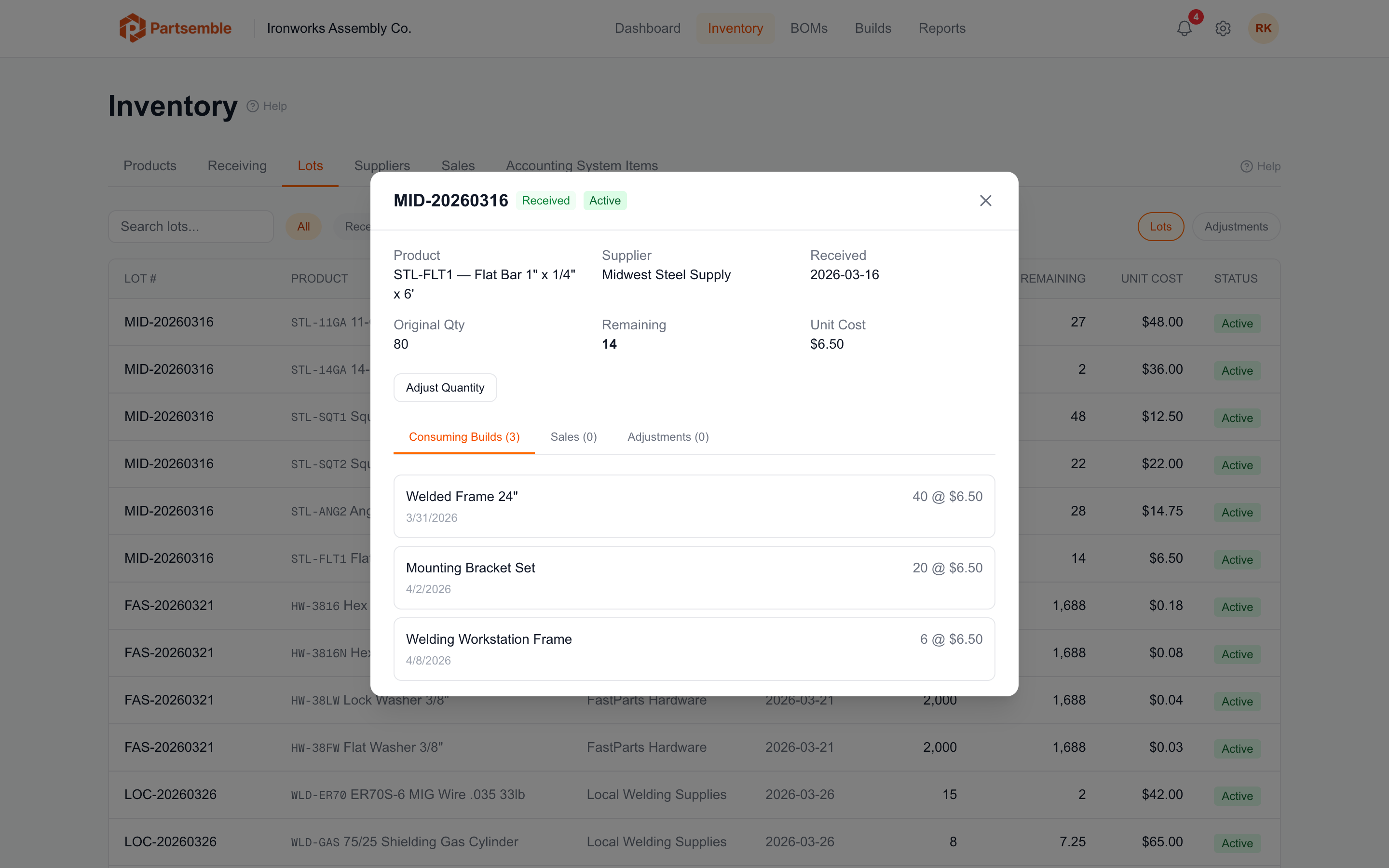
You can view lots for any product on the product detail page. The lot table shows each lot's number, received date, original quantity, remaining quantity, unit cost, and status.
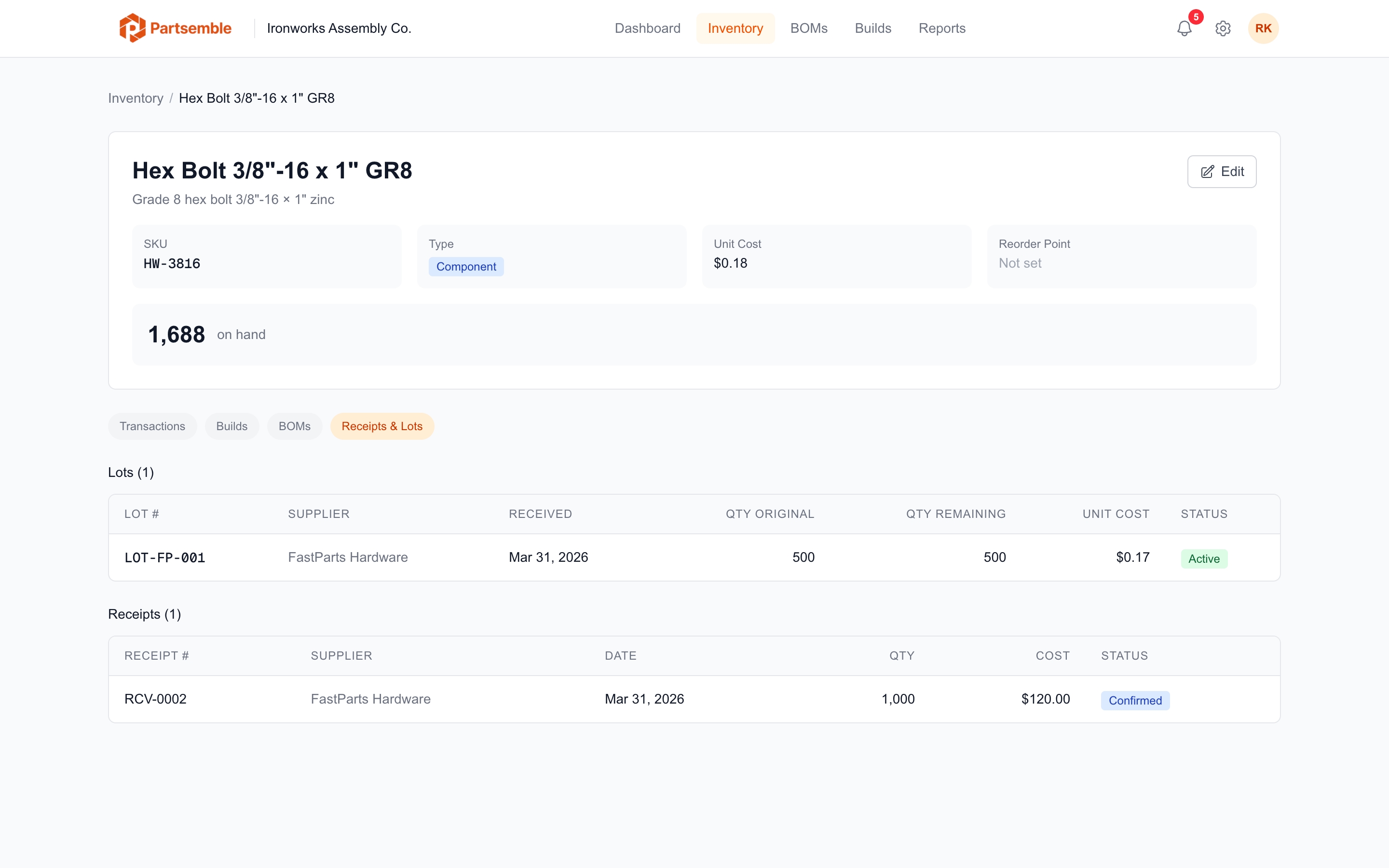
On the receipt detail page, you can see all lots created by that receipt and their current consumption status.
Lot Traceability
The key benefit of lot tracking is traceability. For any build, you can see which specific lots were consumed for each component. For any lot, you can see which builds consumed it. This creates a bidirectional chain:
Forward traceability: Lot → which builds used it → which finished goods contain it
Backward traceability: Finished good → which build produced it → which lots were consumed
This is essential for recall scenarios, quality investigations, and regulatory compliance.